End of Year Accounts

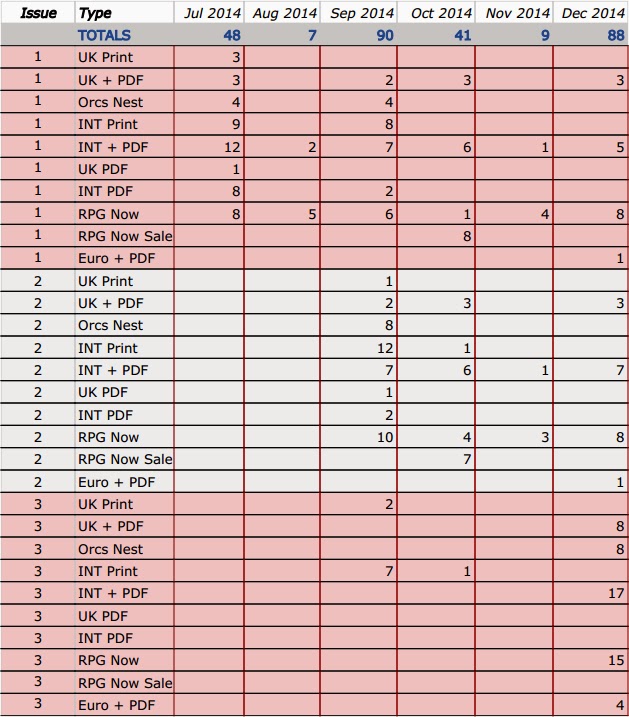
The more-or-less end of the year is an appropriate time to do an assessment of how well this reckless endeavour has gone. Records go from 3/6/14 to 30/12/14.


Sales have remained somewhat flat since the beginning. This is neither spectacular nor terrible. I'm playing for the long game, eventually the back catalogue will be so large and knowledge of it be so common that it will quietly start to turn a profit. At least that's the plan. Being excellent is easy, being consistent is hard.

I must stress here that there is no inherent nobility in running at a loss. I take no pride in it, it is not a good thing and I will put a stop to it as soon as I'm able. If you make something good and worthy you should be compensated and sustained by it.


Commissions are where the money goes. From the beginning I aimed to get to a point where I could pay professional rates and have consistently pushed them up there. Still, from this point I would need to triple them to match something like Weird Tales. Not happening any time soon. At some point I'd like to be able to pay myself similarly. Long game.


Net income: Around -£100 and 60something copies from breaking even. Pretty damn good considering the costs of replacing a printer are included there.


So other than numbers, what did we learn?

  • I'd like to think I'm easy to work with but who knows. Either way, when working closely with another I feel the work is definitely stronger.
  • I have absolutely no idea how good/bad The Undercroft is. I'm not used to this distance from the audience and am endlessly frustrated with it. Unless you hear the sincerity in their words, praise or criticism is hard to take too seriously.
  • As I said the last time I did this, reviews are hard. I don't think a zine is a very reviewable thing, I know I've tried and failed. Do you talk about the work itself? What if it's an anthology work? Is the writing or collecting more important?
  • I still dislike talking to people over the internet. You either sound hysterical or like an arsehole when tippety-typing.

What next?

  • I want to get weirder. Everything so far has been quite tame and in the bounds of what you'd expect from a supplement. Some people have been funny about demon boobs on the cover of #3, I'd like to explore that discomfort some more. Not just through nudity and shock value (although sure, why not), but other ways.
  • Bigger projects. There are 2 books in different stages of development that have taken ideas that were originally going to be blog posts or zine articles. There is a definite A, B, and C class system going on (you're currently looking at the C game).
  • More issues. Short of me dying, I won't stop.


Hopefully someone finds this stuff interesting or useful. I certainly appreciated others doing similar when I was starting.

Humourous Henchmen

I have never remembered what a henchman's morale is. Call me heartless, but they all look the same and are never around long enough to care or find the scrap of paper I pretended to write it down on. Besides, if I got attached to every one of them I wouldn't be able to do my job (i.e. killing henchmen).

So, henchman morale checks; or the "does my henchman run off with all my stuff" roll.

When you meet them you roll for what kind of temperament the henchman possesses and you write it down right there where the players track what the poor fellow is hauling around for them. The dominant humours are listed with the roll penalties used on the following tables:

Sanguine -1
Choleric +1
Melancholic 0
Phlegmatic +2

(the traits of each are listed at the end and may help characterise a henchman that no one much cares for)

To use a past example of a henchmen, who bravely took their own life, we would record their name down as follows:

Volrath the Phlegmatic Foreigner

Possibly. Or you could write it down on a scrap of paper and forget about it, much like you traditionally do with their secret morale. Or not use them at all and just roll.


If they are asked to open a suspicious door or otherwise perform dangerous tasks on your behalf in a capacity outside of their job description:

1-2 Happy to be of assistance
3-4 They do it, but if they are harmed by the experience their faith in you will be rattled  (a 1 cumulative malus on all rolls this adventure)
5-6 They refuse


When asked to guard a pile of gold so large that they could run away and start a new life with it:


1 They cut and run
2 They make a secret nest egg. Steal 2d10 coins per pocket! (They do this without the player's knowledge and will not respond well to random checks. They're sociopathic adventurers as well, don't you know)
3-4 They palm a few coins. 2d10 coins or one small easily concealed item.
5-6 Honest and true


If one of their number dies or some other horrifying event occurs in front of them:

1 Run! Run away!
2-3 Frozen for a number of rounds equal to the number rolled
4-6 Business as usual


How much trouble can a wealthy armed killer get into with his downtime? (Roll this at the start of an adventure or some other convenient in-between bit. Minus 1 to this roll for every full 5 points of damage they took in their last outing; they need to let off steam after almost dying in this dead-end job)

1 Lots, roll twice

2 Some, roll once
3-6 None


Roll D44, do not add humour bonus.
11 They got drunk and talkative at the local social club. Every secret you have that they could reasonably know, they've told in great detail to everyone listening. Expect unpleasant surprises.
12 Your pockets are lightened. The henchman has taken their fair share (in their eyes) and skipped town. Leaving with a recently acquired macguffin, perhaps?
13 They join a competing adventuring company who have just moved into the area.
14Their sketchy past catches up with them. 1, they get killed in their sleep 2-6 their old enemy turns up and starts causing trouble.
21 They start their own competing adventuring company
22 They gambled and lost. They are not only now broke, they owe money to the local seedy underbelly. This can not be resolved by just killing a bunch of guys, the mafiosi will sneak into your inn and stab you while you sleep if you get handsy with them.
23 They elope with a local lover. Skip the next game and return with +1 to all rolls for an adventure due to the refreshing break.
24 A man/woman comes forward as your henchman's illegitimate/abandoned child. 3 in 6 chance it's true. They will either want compensation or to follow in their parent's footprints and join you, whichever is most inconvenient or interesting.
31 A fight breaks out, most likely started by the restless henchman. They take 5d8 damage in bar-room shanking damage.
32 They got arrested on counts of: 1-2 Theft 3-4 Assault 5 Murder 6 All of the aforementioned
33 They went on a legendary bender. Drink, drugs, girls, boys, now! Their hang over is of such magnificent beauty that they nurse it all through the next adventure, suffering -2 to every roll involving thinking or moving.
34 They've been recruited into the Potters Guild militia. They're off to Loch Doldrum to fight the Mud Men and take their precious clay. Steady work, good pay.
41 Their wife/husband has come to retrieve their wayward spouse. Deal with it.
42 They dipped their wick in one too many pots. Syphilis! See Undercroft #1 or just make it up.
43 Drunk in a ditch somewhere. Alive but they miss the next adventure as they find their way home. 
44 Caught in a riddling contest with a retired servant of the Manticore. If they pass an intelligence test they win a trinket from the Manticore's old horde (it will be relatively inoffensive) and D1000 XP.

Sanguine
Friendly, Energetic, Forgiving, Confident, Charming, Talkative
Weak-willed, Egotistical, Gullible, Shallow, Disorganized, Self-absorbed


Choleric
Takes the lead, Independent, Hard worker, Strong-willed, Practical, Determined
Cruel, Rebellious, Stubborn, Insensitive, Arrogant, Rude


Melancholic
Thoughtful, Faithful, Self-sacrificing, Analytical, Organized, Practical
Pessimistic, Morose, Vengeful, Insecure, Shy, Jealous


Phlegmatic
Dependable, Patient, Accommodating, Witty, Calm,  Forgiving,
Docile, Indecisive, Lazy, Stubborn, Indifferent, Yielding,


The Undercroft #3 is out and proud


Oh me oh my, it's happened again.

We have golems seeking treasure while England is upturn'd; wise men and cunning folk, lead by a Dark Star to the Fern Court; and the story of a young man, an old man, & a bridge.

Cover by +Jeremy Duncan, illustrations by +Matthew Adams and +Jim Magnusson.

Writing by +Alex Clements+Barry Blatt and my fine self.


Now on sale. Treat yourself, buy one for the kids, stick them under the Christmas tree and surprise your mum.

Arthurian encounters by the roadside

1.
A white stag bursts from the undergrowth, stops in your path and makes eye contact. For that split second you are all transfixed by its evident majesty, and then it bounds away. Eating its flesh will heal all heart sickness, it's pelt will swaddle the future king, and a crown made from the creature's bones will make the wearer beloved by man and feared by fae.

2.
A young man has stationed himself at the opposite side of a bridge. He challenges you as you approach to single combat so that he may earn his knighthood. Behind him is a tent, a fire pit, and a selection of helmets sitting on top of weapons rudely struck into the ground. If you wade through the river instead of using the bridge he will insult you and question your honour but otherwise not interfere.

3.
The road ahead has been furrowed and the forest on either side is shattered and torn. The giants would never wander this far south, you tell yourself, but the birds speaks volumes in their silence.

4.
A body lays in the middle of the track at the end of a long trail of blood. On inspection his teeth are missing and his eyes have been struck out. There are tiny feathered spines still in the sockets and a silver coin under his tongue.

5.
The path ends suddenly. Perhaps your attention has flagged and your feet have wandered or maybe your map is too old. You turn to retrace your steps and the path behind you is gone. Thick forest abounds.

6.
A knight is struggling by the roadside with who-knows-what. He is quite frantic and looks like he is wrestling with something vicious, but on approaching you discover his sword has just become stuck in the scabbard and he is angrily trying to draw it out by bracing it between his legs and pulling. If you offer to help him he will grumpily accept. After some embarrassing pulling and falling and swearing he throws the sword to the ground and stomps off towards the nearest town ranting about not being stingy when it comes to scabbards. The sword is magical in some rather mundane sense.

Dungeon Camping


When you make camp in the halls of the dead or the ventricles of a monumental stone war machine you must assume a certain degree of risk. By all means, set a watch, make a rotor, look very very hard into the gloom at the fire side. You may have the pleasure of seeing what bloody inconvenience you have brought upon yourself moments before your sleeping associates do.


1.
An enterprising drip has worked its way into your rations and prompted a luminous blue fungal bloom. It glows faintly and is quite pretty, but might be best not to eat them.

2.
Small creatures have made off with a random item in the night. They have replaced it with a bundle of twigs or other appropriate local detritus. An equitable exchange maybe?

3.
You wake up choking. Your mouths and eyes are filled with little puddles of brown water that dribble down your chest as you sit up in a panic. You seem fine but all your metal gear shows sudden signs of rust developing.

4.
You are woken up several times by the distant voices calling your names. Some of your friends claim it's just the wind, but you heard it. None of you count as having had any sleep, even the naysayers.

5.
Your party is awoken by an angry man waving a strip of velum in your face. It has a large seal and apparently entitles them to exclusive rights to the salvaging of this dungeon/cave/ruin/&e. "Them" being a moderately sized adventuring band.

6.
While your watch sleeps and the dreams still hover, you see one of your party enter the fire light and wipe thick juices from their mouth before quietly slipping into their blanket as though they had never left. They claim to remember nothing on waking.

7.
One of you wake up in a different and potentially dangerous location. No one saw you leave or knows where you are.

8.
Everyone wakes up fine and dandy, except for one. That one has an enormous pulsating spider sitting on their face that retreats as the others stir, slipping inside their mouth and down they gullet in a diminishing bouquet of legs. Then they wake up, good as ever.


Develop these in directions prompted by the reactions they receive.

Smashing weapons


My plucky players have entered a megadungeon in the vain hopes of escaping the mind racking adventures of the surface world (the fools!). This opens all sorts of interesting things to mess with based on extended periods spent underground, away from civilisation. Like weapon fatigue, something I've quite fancied for a while.

In real life swords are pretty delicate things, maybe surviving a couple of intense battles before needing a good seeing to. Spearheads come loose, polearms snap, knives bend, clubs splinter &c.

Every time you roll a 1 the die size of your weapon drops. So, a typical sword on rolling its first 1 will fall from d8 to d6. This goes all the way down to d3, where you are reduced to a heavy nub with which to assail the enemy, though rendering pitying looks rather than blood and bruises. Up until this unhappy point it is fixable. Lamentations' rules of "bigger weapon, bigger dice" works very nicely with this, simulating a longer period of usefulness in larger weapons that have more to fall apart. A polearm without a head is still a big stick, after all.


Similarly, by design armour takes a pounding. When a 20 is rolled against you, your armour drops by increments of 1 until it falls apart. Up until that point it can be repaired and patched quite happily.

So, repairs. It will take 10% (modified by local market trends) of the item's value to repair an increment. A sword worth 100 silver pieces that has gone from d8 to d4 would cost 20 silver to repair. While on the road a character that has suitable equipment (whetstone, nails, needle & thread, whatever makes sense) may repair one increment of damage sustained that day.


This system shouldn't be symmetrical. Enemies aren't around long enough and are too varied to make proper use of these rules. Instead, keep a tally per game of how many times you've rolled a 1 for non-players' attacks. Every 4th (5th? 3rd?) 1 rolled will result in that fellow breaking their weapon. As for players rolling 20s, a 20 is its own reward but you could potentially apply the same system: every Nth roll shatters some armour.

I suggest varying the increments each game, possibly going so far as to roll it randomly so as to keep the players from being tempted to count them.


EDIT
Shields, of course. Shields.

If you have a shield you can ignore armour fatigue, however at the end of the fight there is a 1 in 3 chance that the shield is knackered beyond use.


Entirely unrelated point:
If you don't know why a location is named the way it is then it probably shouldn't be named as such. The people living there don't need to know, but you should. In countries that have existed for more the a few generations place names are very literal and locals are usually aware of the history.

Books as remembered (poorly) by me, Part 2

On by Adam Roberts


I sometimes feel I'm the only person who's read this, a (sci-fi?*) book from the well respected Adam Roberts. That is of course until I meet someone who has read it, but then I find out they hated it so instantly expunge the conversation from my memory. Can't be wasting mind space on people who are so very, very wrong.

The link above will give you a plot synopsis and a bunch of people grumbling about it (remember: wrong) so I'll spare the details and get to why this book makes games better and everyone should read it and agree with me.

World building is important, obviously. How you do it is your own business but consider the option of being totally fucking mental. On takes place on a vertical world, The Wall, with platforms and outcroppings all the way up it that people live on. At various points they think about what's on the other side, or what's at the top, or why they can't fly very far out before they get pushed back in. Pretty crazy, huh? But wait! It's not. Mr. Roberts explains in a chunky essay in an appendix that the book is on Earth after a (apparently vaguely plausible) shift in gravity, so that it spirals around the world rather than pulls us down. There is no other side of the wall, there is no top, and you can't fly far out 'cos that's just space up there. And he didn't tell us in the fiction. Of course you could possible piece it together, but that's not the point.

So what is the point? Good question, me. The point is that he had a hidden keystone that connected everything in his setting together. If we had access to it then it would all click together, all the strangeness, everything that just didn't make sense. It did make sense.


The practical application here being: start with a keystone, extrapolate out, then hide it. It creates a wonderful logic that can only be seen from a specific angle, and one day you can hand over the keystone or have it taken from you, whereupon everyone will go ah ha, we're so smart!

Round of applause.

Besides this there are a few incredible portions of the book that translate to more concrete things that can be stolen, all need to be read to be used. The war fought through a vertical jungle full of tiger sized carnivorous earwigs, a trader who uses children as walking larders, and that god damn alien. Three pieces that will prove excellent fodder for theft.


* Like all good fantasy/sci-fi it resists easy labels but it most certainly generically inclined. Talking of genre, when are we going to admit that the fantasy/sci-fi genre split is ridiculous. They're the same bloody thing.

Books as remembered (poorly) by me, Part 1

I like talking about books, so I'm going to do that for a while. You could call what I'm about to do an Appendix N, but let's not. That term holds no meaning to me, I never saw the Appendix N when it came out and only learnt about it from other people whispering about it in corners. Spurred on by their hushed tones I found a digital copy of it and was shocked at how tiny and narrow it was. It's called a bibliography.

So here's part 1 of my annotated bibliography. I'll spare the waffle and just serve the meat.


Gene Wolfe


Gene Wolfe looms large in my lizard brain. Where there should be fight or flight responses and the urge to feed and fuck, I have the need to be Gene Wolfe.


Recommended reading:

Book of the New Sun
Latro in the Mist
Wizard Knight


All of these books are written as artefacts, two diaries and one long letter. All have unreliable narrators. Severian in Book of the New Sun is moving through a world that is as weird as anything on Dying Earth, yet we aren't given a proper look at it because that's just how it is for Severian. Everything is filtered through someone to whom this is normal or only slightly odd, leaving us wondering what's really happening. On top of this we also have the "translation" performed by Gene Wolfe, who claims the book is a found text which has to be very generously translated because of a lack of better words for such alien things. Many of these approximations are very weighted classical Greek references that reward knowledge of them.

These are all interesting things.

Both Latro and Wizard Knight are probably better written works, tighter and more disciplined. Each experiments with form in interesting ways, Latro is writing the diary because he forgets everything each morning. He is the opposite of Severian, being pure eyes for us to see through. The reader is more informed of what is happening than that poor fellow is, we having the ability to contextualise what he is writing.

Wizard Knight has the least experimental form: a letter written to his family back in the mundane world explaining why he isn't coming home. A portal fantasy, which is rare nowadays in adult fiction. This book is subtle and doesn't lean so heavily on classical references, instead creating an internal folk lore that requires extreme attention to unravel.


Of the three, Book of the New Sun is the undoubted king of influence. I read it at a formative time, way back when I started writing properly, and it has embedded itself. Every bit of literature, poetry or RPG thing that I do is held up against this book and judged. There are other books (as we might see later) that have had a more profound impact on a fundamental creative level, none have come close to the consciously chosen influence this has.


What did I learn?


  • It is okay to not make sense, to be obscure and referential. You don't need to lead the reader by the nose or particularly help them in any way.
  • Experimental forms can work if you throw everything in to them. We are not just making lists of facts to be absorbed, we can make things that tickle at an obtuse angle.
  • Narrators matter. Even in RPG books, a narrator is a choice that we make. 
  • Create the weird as though it is part of the furniture. Do not point.
  • It is okay to have a full three act play in the middle of your work.
  • Be weird, but have a logic to it. Even if only you know how it connects, it should connect.
  • Be unapologetically literate.
  • Anti-intellectualism and pop-cultural absorption is a choice, so make it or don't. Don't allow yourself to be washed along because that's how it's done.
  • Foreshadowing and slow realisation is the greatest thing. When weeks later a player goes "Oh my shit..." and links everything together in a montage of paranoia, then you have Gene Wolfed them.